
In the last few weeks, I have been making a conscious effort to clean out my office. I am habitually behind in keeping up with my Harvard Business Review subscription and decided that, as part of this clean out, I would catch up on my reading. In the November 2016 issue of the HBR, there’s a fascinating article entitled “Right Tech, Wrong Time” by Ron Adner and Rahul Kapoor. The article stresses the criticality of the ecosystem in the viability, acceptance and success of technology innovations. It’s a truly fascinating article that I encourage everyone to read. There are a number of extremely interesting concepts that apply to the Space 2.0 movement.
Space 2.0
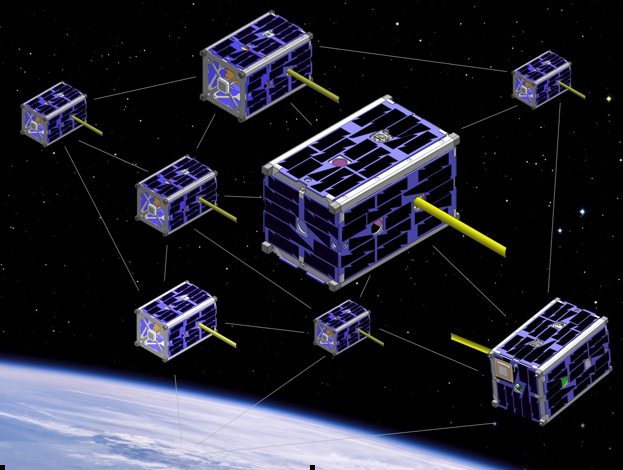 For many, Space 2.0 (or New Space as it’s sometimes called) represents the next Space Age – distinctly different from that which has come before. With the notable exception of the commercial telecommunications industry, the astonishing achievements of the previous space age (I.e the last 50 years) has been driven primarily through massive government investments. These investments have provided the funding, and in many cases, the focus, for our space research, exploration, and broad usage of space. Space 2.0 shifts the focus from exploring space to that of utilizing space as a broad arena for commerce fueled by entrepreneurial zeal and commercially backing.
The last year has seen a significant maturing of the Space 2.0 community. Business models, technology hurdles and opportunities, as well as return on investment expectations have significantly evolved in the last year. In that time, there have been some notable successes:
- Continued success in development and deployment of commercial low-cost imagery satellites and constellations (e.g. Planet and Blacksky Global)
- Demonstration of the viability of the US Government as an actual paying customer for Space 2.0 data products (NGA imagery buy with Planet, NOAA space weather trial data buy with GeoOptics and Spire Gobal)
- Additional investment of $1B in OneWeb by Softbank in Japan which supports the continued development of the OneWeb constellation.
However, with these successes come some equally notable setbacks such as Firefly Space Systems and Swiss Space Systems. These two apparent casualties reinforce the fragile commercial realities of any emerging market, including Space 2.0. While these two endeavors had different challenges, a rarely discussed but critical element to the success of any new or innovative technology is the ecosystem surrounding it.
Space 2.0 and the Overall Ecosystem
Why do we care about the Space 2.0 ecosystem and how does it shape the competitive environment? Many an entrepreneur confidently believes that they have a truly innovative idea, superbly suited technology, customers lined up and it’s about to start raining money. While that belief is essential to entrepreneurial success, is it enough? Are they really sufficient for the anticipated financial windfall expected by founders and investors? Avoiding for now the critical role of Lady Luck in the process, understanding the role of the ecosystem (and that of competing ecosystems) is critical to any endeavor. Adner and Kapoor insightfully point out that “Both established and disruptive initiatives depend on an array of complementary elements – technologies, services, standards, regulations – to deliver their value proposition.” It’s this full ecosystem which enables success.
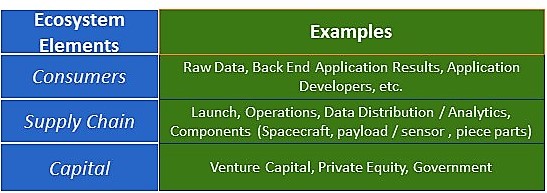
In the context of Space 2.0, I like to think of the overall ecosystem in terms of three segments, as shown in the figure below. Each of these elements represents core aspects of any business value proposition. Whether it’s delivering payloads to orbit, providing early company financial forecasts based on space based data analytics, or tracking the movement of ships and cargo, these elements are all there.
Competition Between Ecosystems
The competition between ecosystems is a concept discussed at length by Adner and Kapoor. Just as the burgeoning Space 2.0 ecosystem is critical to the successful realization of this movement, the ecosystem supporting traditional space represents is, in many ways, a competing force. Just as new technology can be held back by limitations in their ecosystem (e.g. launch costs), traditional or incumbent technology can be accelerated by improvements in theirs. You can see this improvement in everything from reducing the cost of on orbit operations, driving supply chain prices down, and increased access / openness to competing data products (e.g. Copernicus imagery data products).
In the terms of the space industry, it is essential to understand the reality of this competition between ecosystems – one which plays out with a direct struggle for strategic resources including funding, technology products, and clients. Examples of this competition include:
- A novel Earth Observation (EO) application which must compete for customers with traditional high resolution space imagery from existing large commercial and government space systems.
- Low cost Space 2.0 small satellite manufacturers which compete with traditional satellite manufacturing. The key feature of this competition is the lower cost and shorter delivery schedules of the Space 2.0 community compared with traditional satellite manufacturers. However, traditional space satellite providers counter through the advantages offered by their higher reliability and years of proven on-orbit success.
- A space startup focusing on enhanced space weather prediction competes with a mature set of space assets which are nationally funded and openly provide the data products for public use.
To understand the relationship between these types of ecosystems, Adner and Kapoor created four scenarios:
- Creative Destruction
- Robust Resilience
- Robust Coexistence
- Illusion of Resilience
Obviously, Space 2.0 is not a homogenous entity with a single competitive relationship with traditional space. It’s a complex and diverse movement across a variety of applications and domains. In Part II of this series, we’ll use these four scenarios to explore how the various facets of Space 2.0 relate to the traditional space sector.
Recent Comments